Sundowning turns predictable people into anxious wanderers by 4pm, and if you're searching for memory care for sundowning and wandering right now, you're probably exhausted from managing it alone. This guide breaks down what actually reduces evening agitation and nighttime exits, and what looks reassuring on a tour but fails at 9pm.
- Small adult family homes with awake overnight staff, like Essential Living Adult Family Home in Salmon Creek/Vancouver, WA, handle sundowning better than large corridors in 2026.
- The Alzheimer's Association reports six in 10 people with dementia will wander at least once, so alarmed exits are non-negotiable.
- Skip any memory care setting that relies on a sleeping night shift for a resident with active nighttime wandering.
- Structured evening routines and 24-hour awake staffing are the two criteria that matter most for memory care for sundowning and wandering.
Why this matters
Sundowning isn't a personality change, it's a predictable neurological pattern where confusion, agitation, and the urge to "go home" spike in late afternoon and evening. Wandering is what happens next when a confused resident acts on that urge, and it's the single most dangerous behavior families face in dementia care. A setting built for daytime supervision but thin on evening staffing will miss both.
Families searching for memory care for sundowning and wandering are usually past the point of managing it at home safely. That's the right instinct. What matters now is picking a care setting matched to the specific behavior pattern, not just a general "memory care" label on a brochure.
Who this is for
This guide is for adult children and spouses evaluating care for a parent or partner who gets agitated, confused, or restless starting in the late afternoon, and who has attempted to leave the house, a room, or a bed unsupervised. If your loved one is calm all day and only shows confusion occasionally, a lighter-touch assisted living option may be enough. If evenings are consistently hard and there's been even one wandering incident, you need a setting built around overnight supervision, not just daytime programming.
What to look for in memory care for sundowning and wandering
Awake overnight staff, not a sleeping shift
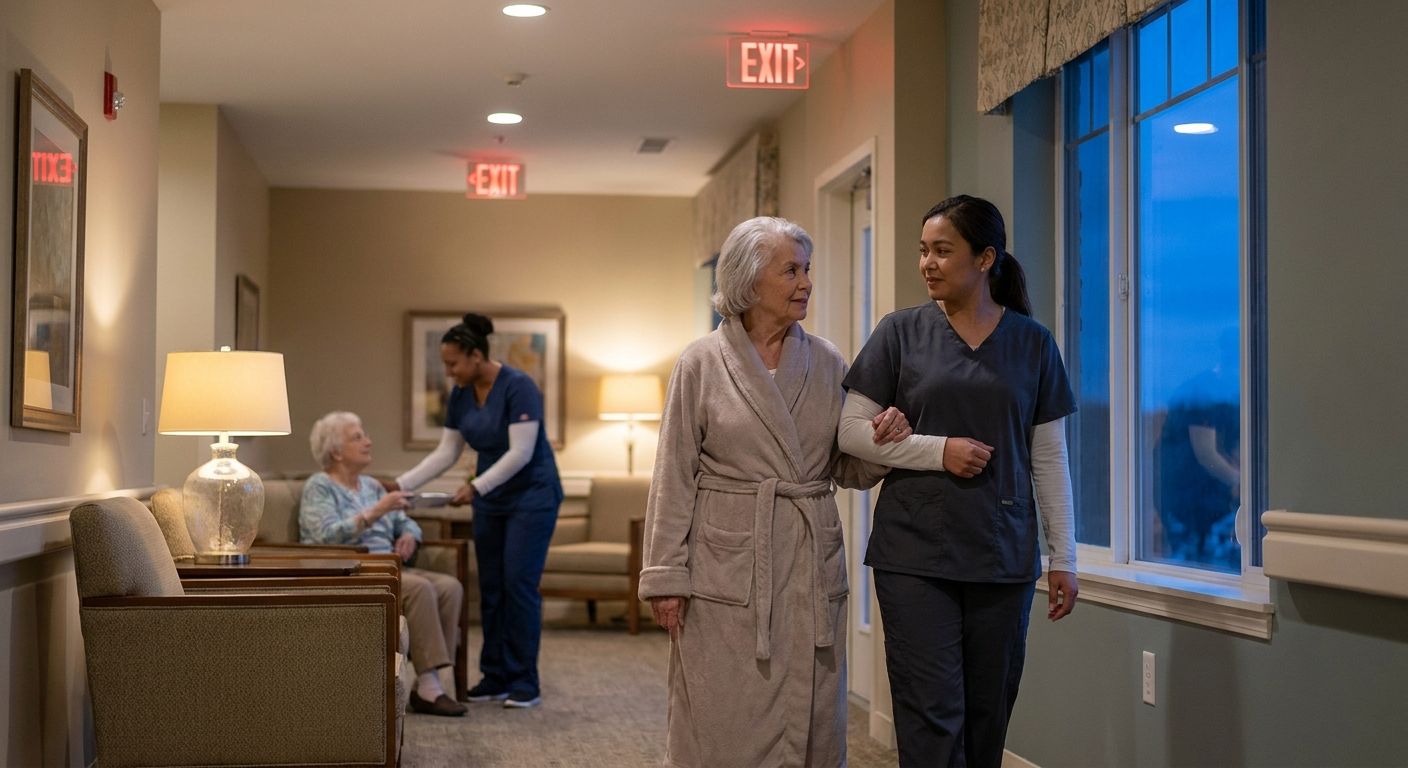
Many memory care communities staff overnight with someone who sleeps on-site and wakes for emergencies. That works for residents who sleep through the night. It does not work for sundowning, where the highest-risk window often runs from early evening into the middle of the night. Ask directly: is staff awake and mobile at 2am, or asleep in a back room until an alarm sounds?
Secured, alarmed exits
The Alzheimer's Association estimates that six in 10 people living with dementia will wander at least once, and repeat wandering is common once it starts. Door alarms, coded exits, and enclosed outdoor space aren't extra features here, they're the baseline. A setting without alarmed exits is a liability for a wanderer, no matter how nice the common room looks.
A small, home-like layout over long corridors
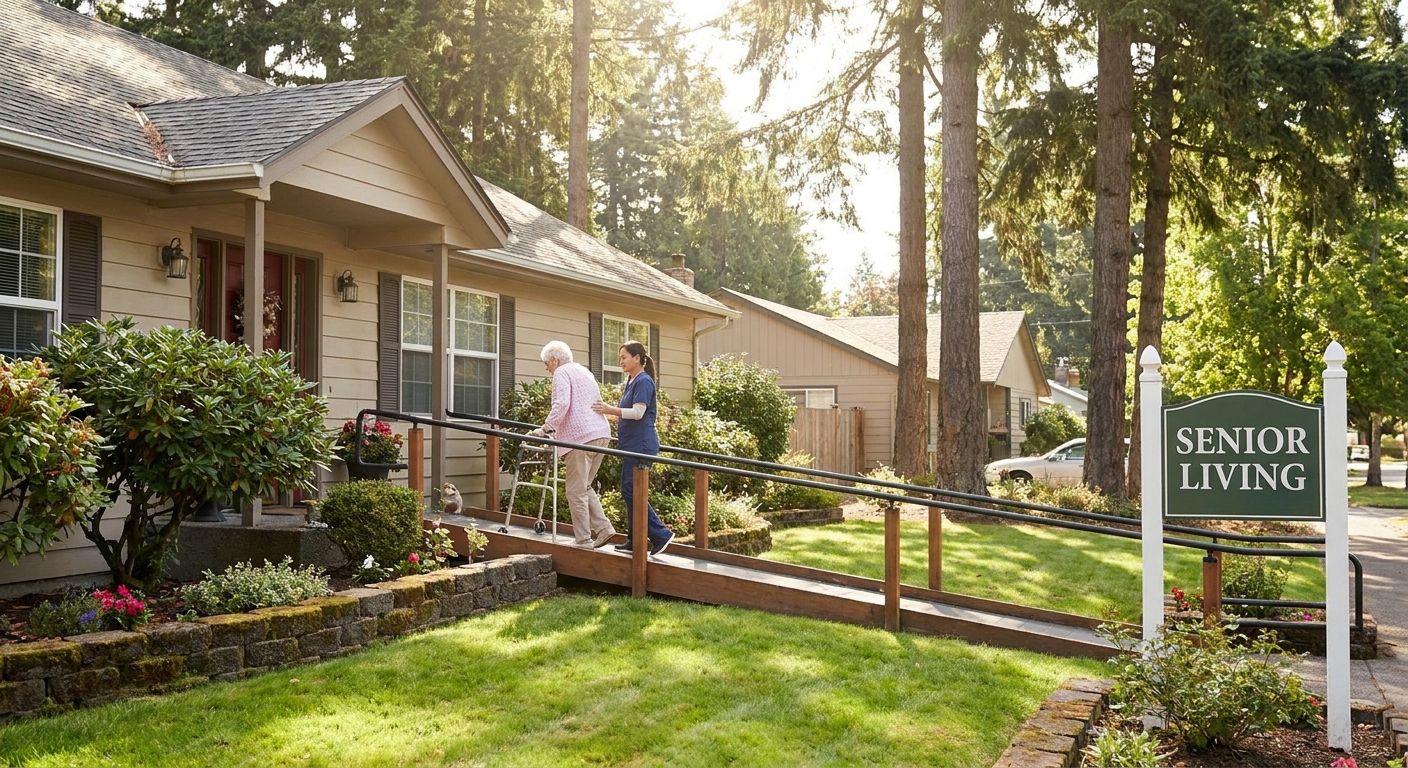
Long hallways and identical doors increase confusion for a sundowning resident trying to find "their room" at 7pm. Smaller settings with fewer residents and simpler layouts reduce the disorientation that triggers agitation in the first place. This is one reason adult family homes with 5-6 residents often outperform 40-bed memory wings on evening behavior.
Structured evening routines
A fixed dinner time, dimmed lighting after dusk, and a consistent wind-down routine reduce sundowning triggers more reliably than medication alone in many cases. Ask what the 4pm-9pm schedule actually looks like, not just the daytime activity calendar shown on the tour.
Medication management timed to behavior patterns
If medication is part of the plan, timing matters as much as dosage. A setting that adjusts medication timing around a resident's individual sundowning pattern, rather than a fixed facility-wide schedule, is doing real medication management, not just pill distribution.
Direct, fast family communication
When a wandering incident happens, you want a phone call within minutes, not a note in a weekly update. Ask how incidents get reported and how quickly, before you sign anything.
Top picks by setting type
Small adult family homes with awake overnight staff — the steady pick. These settings typically house 5-6 residents with a caregiver ratio built for that number, not a wing of 40. Verdict: Buy if the home confirms awake, mobile night staff and alarmed exits; this is the setting type built specifically for sundowning and wandering behavior.
Large corporate memory care campuses — the scale play. These offer more staff on paper and more programming variety, but overnight coverage often thins out across a bigger floor plan, and corridors are longer by design. Verdict: Consider only after confirming actual overnight staff-to-resident ratios in writing, not the daytime number on the brochure.
In-home care with door alarms and cameras — the stretch option for families not ready for a move. This keeps a loved one in a familiar environment, which can reduce some sundowning triggers, but it depends entirely on hired caregiver reliability overnight and lacks the built-in redundancy of a staffed home. Verdict: Consider for early-stage sundowning without prior wandering incidents; Skip once a wandering incident has already occurred.
Secured assisted living memory neighborhoods — the middle ground. These sit between a small adult family home and a full nursing facility, with locked memory wings inside a larger building. Verdict: Consider if the memory neighborhood itself is small and staffed around the clock, but verify it's not just a locked hallway inside an otherwise standard assisted living building.
Talk through your loved one's sundowning pattern
Get a direct answer on overnight staffing and safety setup for memory care for sundowning and wandering.
What to avoid
- A community that emphasizes daytime activities but goes quiet on overnight staffing questions. If they can't tell you the exact overnight ratio, assume it's thin.
- A "memory care" label without an actual secured unit. Some communities market memory care as a program, not a physically secured space, which does nothing for a wandering resident.
- Large facilities that rotate staff nightly. Unfamiliar overnight caregivers are less able to recognize a resident's early agitation cues, which matters most in the hour before a wandering attempt.
Verdict comparison
| Setting type | Awake overnight staff | Secured exits | Ratio (typical) | Verdict |
|---|---|---|---|---|
| Small adult family home | Yes, if confirmed | Standard | 5-6 residents per home | Buy |
| Large memory care campus | Varies by shift | Standard | Higher resident count per wing | Consider |
| In-home with alarms | Depends on caregiver | Home-based only | 1:1 | Consider/Skip |
| Secured assisted living neighborhood | Varies | Standard | Mid-size unit | Consider |
FAQ
What is the best memory care setting for sundowning and wandering?
A small adult family home with awake overnight staff and alarmed exits is generally the best fit for sundowning and wandering in 2026, because staffing and layout are built around evening and nighttime supervision rather than daytime programming alone.
Is sundowning the same as wandering?
No, sundowning is the late-afternoon and evening confusion or agitation pattern common in dementia, while wandering is a behavior that can result from it. Not every sundowning resident wanders, but wandering risk rises sharply during sundowning hours.
How common is wandering in dementia patients?
The Alzheimer's Association estimates six in 10 people with dementia will wander at least once. That's why alarmed exits and secured layouts are treated as a baseline requirement, not an upgrade, in memory care for sundowning and wandering.
Does medication stop sundowning?
Medication can reduce agitation for some residents but rarely eliminates sundowning on its own. Structured evening routines, consistent lighting, and dedicated staff attention typically matter as much as medication timing.
Is a large memory care facility or a small adult family home better for wandering risk?
A small adult family home with 5-6 residents and awake overnight staff generally manages wandering risk better than a large facility, because shorter hallways and closer staff supervision reduce the disorientation that triggers wandering attempts.
What should I ask a memory care community about nighttime staffing?
Ask whether overnight staff are awake and mobile or asleep on-call, and ask for the actual overnight resident-to-staff ratio in writing. A community that hesitates to answer directly is a warning sign for a sundowning resident.
Can in-home care manage sundowning and wandering safely?
In-home care with door alarms can work for early-stage sundowning without prior wandering incidents, but it depends entirely on caregiver reliability overnight. Once a wandering incident has happened, a staffed setting is safer.
How fast should a memory care community notify family after a wandering incident?
You should expect a phone call within minutes of any wandering incident, not a note in a weekly update. Ask about the exact notification process before choosing a setting.
One last thing
The detail families miss on tours is lighting: sundowning agitation often eases with earlier, warmer, dimmer evening lighting starting well before dusk, not after it. Ask any care setting in 2026 what time they start adjusting lighting for the evening, not whether they "have a routine." The specific start time tells you whether the routine is real or a talking point.