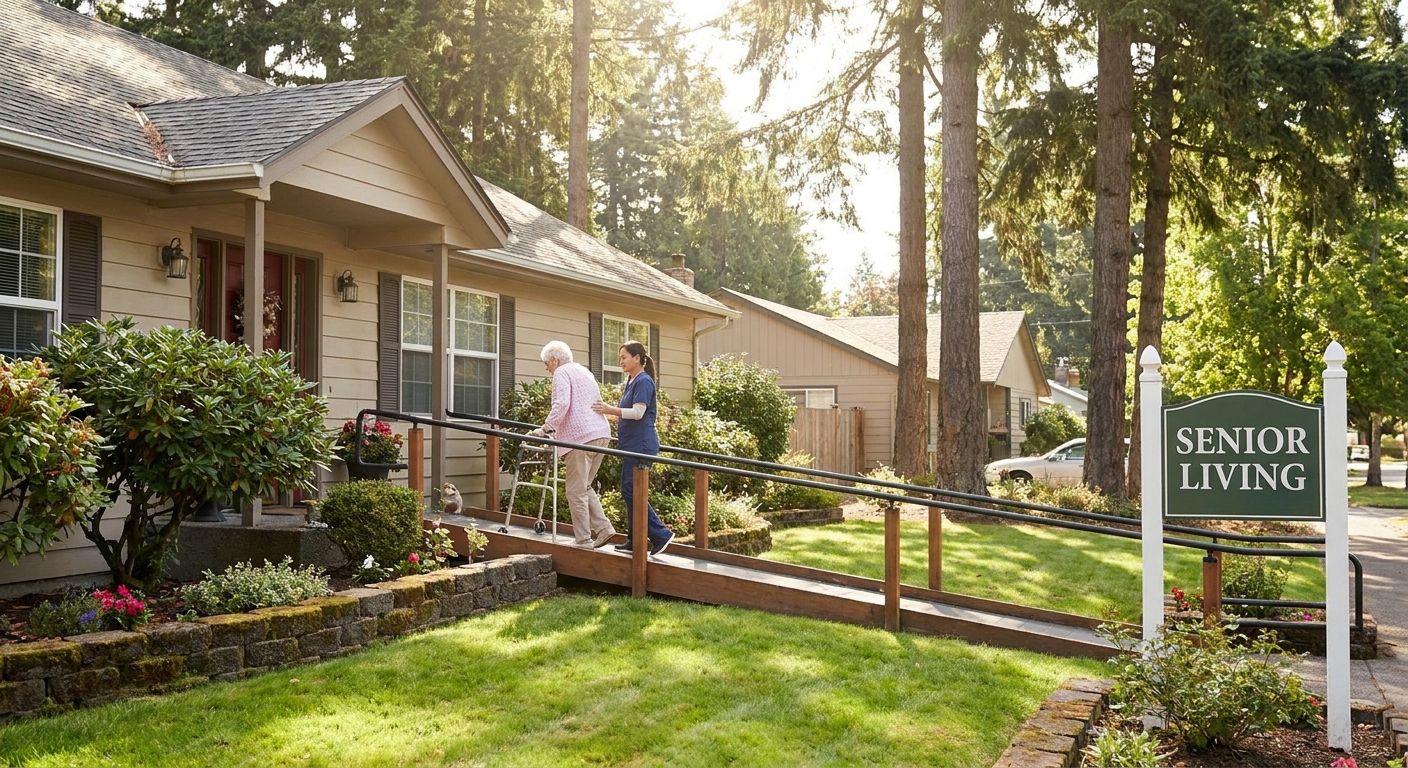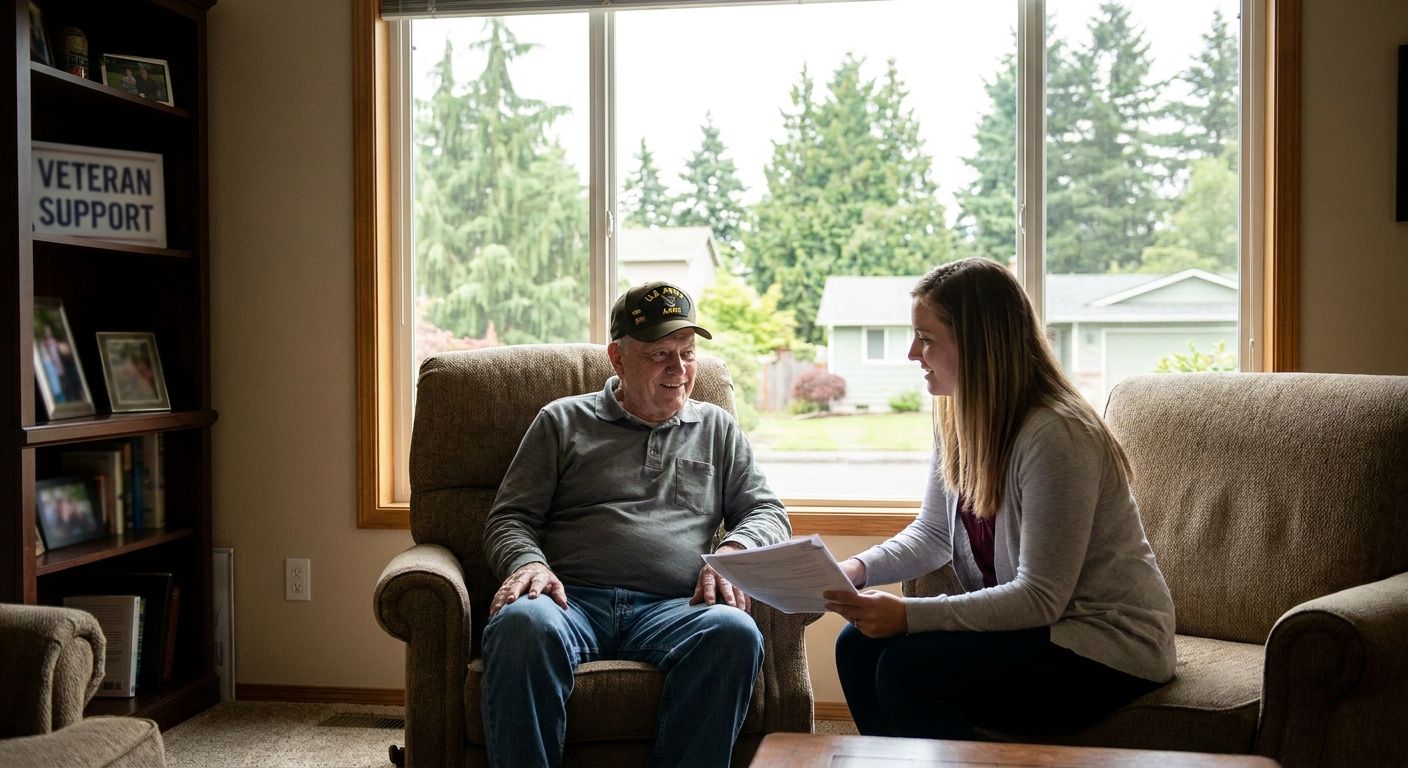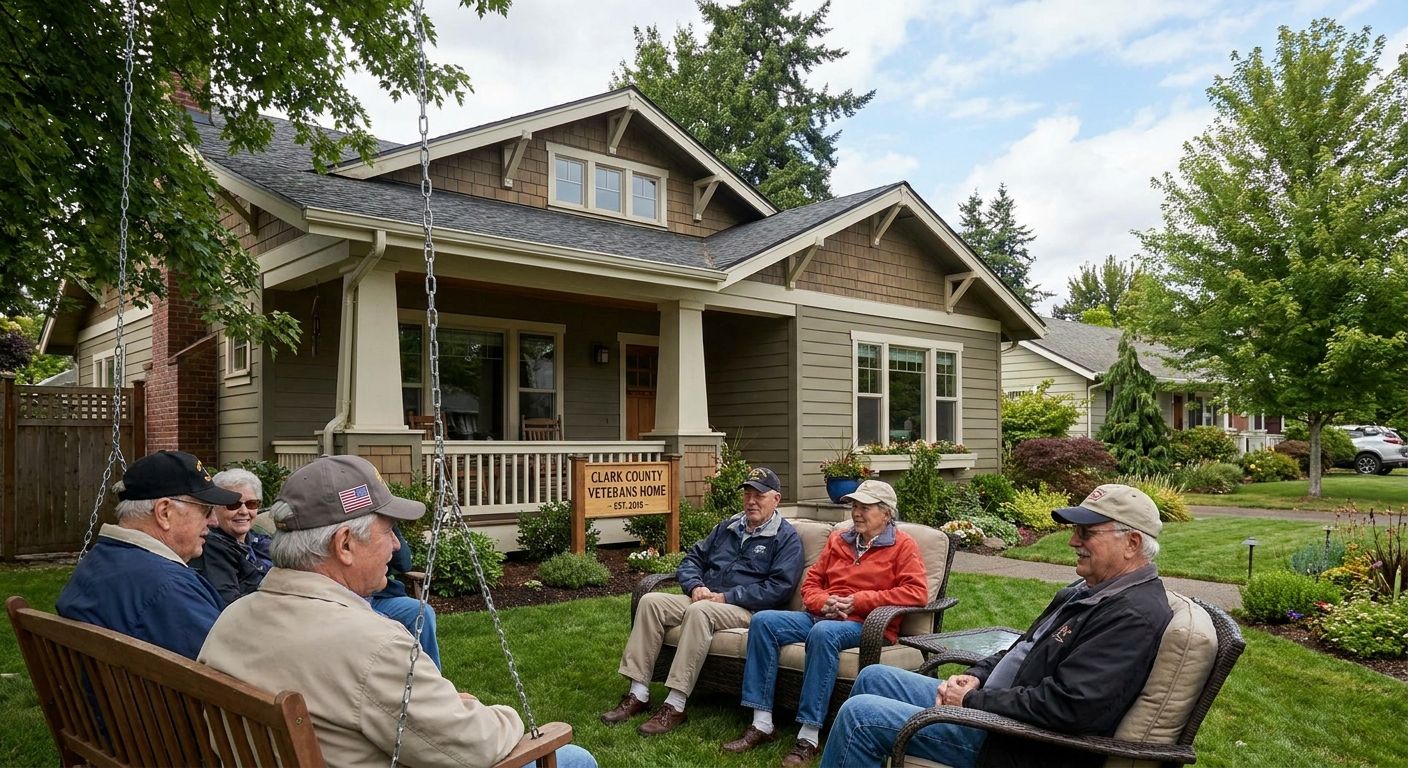
Finding an adult family home for veterans in Clark County means matching a real person's service history, health needs, and pride in independence with a setting that feels like home, not an institution. This guide breaks down what actually matters for veteran residents and their families weighing options in the Salmon Creek and Vancouver, WA area.
- Essential Living Adult Family Home in Salmon Creek offers 24-hour veteran care in Clark County — Buy for daily hands-on support.
- Memory and dementia support matters for veterans with combat-era cognitive changes; verify staff training before touring.
- VA Aid & Attendance pension benefits can help offset adult family home costs — ask the home how they handle VA paperwork.
- Washington State licenses adult family homes for up to six residents, which keeps the setting small and family-style.
Why this matters
Veterans aging into their 70s, 80s, and 90s often carry health complications that a generic senior living brochure doesn't address: hearing loss from service-related noise exposure, mobility limits from old injuries, and in some cases dementia that shows up differently than it does in the general population. A large assisted living facility with rotating staff and a 40-resident dining hall isn't built for a veteran who wants quiet, routine, and people who actually know his name.
An adult family home for veterans in Clark County solves a narrower problem: real 24-hour supervision in a residential house, not a hospital wing. Essential Living Adult Family Home operates on exactly that model in Salmon Creek, and in 2026 that distinction matters more than ever as families compare costs and care quality across the region.
Who this is for
This guide is for adult children, spouses, or veteran service officers researching residential care for a veteran who can no longer safely live alone but doesn't need hospital-level medical care. It's also for the veteran making the decision himself or herself, still capable of weighing in on where to live next. If the veteran needs skilled nursing or ventilator-level care, a nursing facility is the right call — an adult family home is built for daily living support, not acute medical treatment.
What to look for in an adult family home for veterans
24-hour staffing, not scheduled check-ins
Veterans with nighttime confusion, sleep disruption, or fall risk need someone present around the clock, not a caregiver who visits twice a day. Confirm the home staffs overnight and ask what the staff-to-resident ratio looks like after 9 p.m., since that's when most falls and wandering incidents happen.
Memory and dementia care experience
Dementia in veterans sometimes overlaps with PTSD symptoms from decades earlier, and a caregiver untrained in that overlap can misread agitation as something else. Ask directly what dementia-specific training staff have completed and how they de-escalate confusion without restraints or over-medication.
Medication management that catches interactions
Many veterans manage five or more prescriptions for chronic conditions like diabetes, hypertension, or chronic pain from service injuries. A home that handles medication management should track dosing times, refill schedules, and flag interactions before a pharmacist has to catch the mistake.
Small, home-like environment over institutional scale
A 6-resident adult family home means staff learn a veteran's habits, preferences, and moods instead of managing him as one of forty names on a clipboard. That size cap, set by Washington State licensing rules, is the structural reason family-style homes feel less clinical than larger facilities.
Familiarity with VA benefits paperwork
The VA Aid & Attendance pension benefit can help cover the cost of an adult family home for eligible veterans and surviving spouses, but the application process is dense. A home that's walked families through VA paperwork before saves weeks of confusion versus one encountering it for the first time.
Proximity to Clark County VA resources
A location in or near Vancouver, WA keeps veterans closer to the Portland VA Medical Center and local Veterans Service Officers for benefits appointments, without a long drive that gets harder as mobility declines.
Care scenarios and verdicts
The veteran aging in place alone, no cognitive decline yet. He's safe today but family worries about falls, missed medications, and isolation. A home with 24-hour supervision and daily living assistance covers exactly this gap before a crisis forces a rushed decision. Essential Living Adult Family Home provides that level of daily support in a residential setting in Salmon Creek. Buy — this is the textbook case for moving before an emergency, not after one.
The veteran with early-stage dementia or memory loss. Confusion is starting to show — missed appointments, repeated questions, occasional disorientation. Memory and dementia support paired with 24-hour staffing matters here more than any other single factor, because early intervention slows the crisis curve. Buy — waiting until a wandering incident forces the issue almost always means a harder transition later.
The veteran who is fiercely independent and resistant to any care setting. Some veterans equate needing help with losing autonomy, and a large facility that feels institutional will meet real resistance. A small, family-style home with six residents or fewer, where staff build a relationship instead of running a shift, tends to lower that resistance. Consider — tour with the veteran present and let him ask the questions; forcing the decision without buy-in usually backfires.
The veteran needing acute medical or skilled nursing care. If wound care, IV therapy, or ventilator support is required, an adult family home isn't built for that level of medical intervention. Skip — this scenario calls for a skilled nursing facility, not a residential care home, no matter how warm the setting feels.
What to avoid
- A facility that can't clearly describe its dementia training. Vague answers like "our staff are experienced" without specifics on de-escalation methods are a red flag, not reassurance.
- Any home unfamiliar with VA Aid & Attendance. If the staff have never helped a family through that paperwork, the family ends up doing it alone during an already stressful transition.
- Facilities sized well past the family-home model. A building with 20+ residents marketed as "cozy" is still an institution; the six-resident cap under Washington State licensing is what actually keeps care personal.
Tour a veteran-friendly adult family home
See the Salmon Creek home and ask about VA benefits support in person.
Verdict comparison
| Criteria | Why it matters for veterans | What to confirm on tour |
|---|---|---|
| 24-hour staffing | Covers nighttime falls, confusion, medical events | Overnight staff-to-resident ratio |
| Memory/dementia care | Combat-era cognitive changes need specific training | Staff dementia training and de-escalation approach |
| Medication management | Multiple chronic-condition prescriptions common in veterans | How refills, dosing, and interactions are tracked |
| Home size | Small, family-style setting vs. institutional scale | Confirm resident count under WA's 6-resident cap |
| VA benefits familiarity | Aid & Attendance can offset costs | Ask how many VA families the home has assisted |
| Location | Proximity to VA medical resources in Clark County | Drive time to Vancouver, WA VA services |
FAQ
What is an adult family home for veterans in Clark County?
It's a licensed residential home, capped at six residents under Washington State rules, that provides 24-hour daily living assistance, medication management, and often memory care in a house setting rather than an institutional facility. Essential Living Adult Family Home in Salmon Creek operates on this model for elderly residents, including veterans, in the Vancouver, WA area.
Can VA benefits pay for an adult family home?
The VA Aid & Attendance pension benefit can help eligible veterans and surviving spouses cover the cost of residential care, including adult family homes. Contact a Veterans Service Officer or the home directly to confirm eligibility and current 2026 application steps.
Is an adult family home better than a nursing home for veterans?
It depends on medical need: adult family homes suit veterans who need daily living support and supervision but not skilled nursing or acute medical treatment. A veteran requiring IV therapy, wound care, or ventilator support needs a nursing facility instead.
How much does an adult family home cost for veterans in Clark County?
Costs vary by care level and the individual home's rates, and pricing can shift year to year. Ask Essential Living Adult Family Home directly for current 2026 rates and how VA Aid & Attendance benefits might apply.
Do adult family homes provide memory care for veterans with dementia?
Many do, including specific training for staff to handle confusion, agitation, and wandering risk without restraints. Confirm the specific dementia training a home's caregivers have completed before enrolling a veteran with cognitive decline.
How many residents live in a typical adult family home in Washington State?
Washington State licenses adult family homes for up to six residents, which keeps the environment small and family-style compared to larger assisted living facilities. That size cap is a core reason families choose this setting over institutional care.
What should I bring on a tour of an adult family home for a veteran?
Bring the veteran's current medication list, any VA benefits documentation, and a list of specific daily habits or preferences to test how well staff can accommodate them. Bringing the veteran along, when possible, also helps gauge comfort with the setting firsthand.
Is Essential Living Adult Family Home located near Clark County VA resources?
Essential Living Adult Family Home is located in Salmon Creek near Vancouver, WA, keeping residents within reasonable distance of Clark County and Portland-area VA medical resources for benefits appointments and follow-up care.
One last thing
The detail families overlook most: Washington's six-resident cap on adult family homes isn't a marketing angle, it's state licensing law, and it's the actual mechanism that keeps staff-to-resident attention high enough to catch a missed dose or a bad night before it becomes a hospital visit. Ask any facility how many residents they're licensed for before asking anything else — the answer tells you more about daily care quality in 2026 than almost any brochure claim.